



Quick Summary
.Bathroom smells are worth taking seriously, because a drain that smells is telling you something specific. Either the barrier between your bathroom and the drainage has failed, or something is decaying inside the pipe.
This guide explains what causes a smelly bathroom drain, how to tell a lost water seal from a build-up inside the pipe, and the spots people miss when the odour will not shift. It also covers safe cleaning, and the signs that point to a fault in the drainage rather than the fitting. If the problem needs professional attention, bathroom repair services in Harrow can help address the underlying issue.
What the smell itself is telling you
Identify the odour before touching anything, because the type points straight at the cause.
A sewage or rotten egg smell suggests drainage gases reaching the room, usually through a trap that has lost its water. Hydrogen sulphide is what gives it that eggy edge, and it tends to be constant rather than tied to using the shower.
A sour, stale odour that gets stronger while water is running is a different animal. That is bacterial build-up inside the waste pipe being disturbed by the flow.
Musty or earthy smells point elsewhere entirely, usually to damp, poor extraction or a leak behind a panel. Chasing the plughole in that case wastes an afternoon.
The water seal, and why it disappears
Every waste fitting has a trap holding a plug of water that blocks gases from coming back up the pipe. Building regulations generally call for a 75mm seal, with a shallower 50mm seal allowed in limited situations such as a ground floor appliance discharging to a gully.
Lose that water and there is nothing between the room and the drainage. Here is how it usually happens.
Evaporation in a room that is not used
A guest ensuite or a spare shower left unused for a few weeks will simply dry out, especially in a warm house. Running the tap for half a minute refills it, and a small amount of cooking oil poured in afterwards slows the next evaporation by sitting on the surface.
Siphonage pulling the seal out
A long or steeply laid waste run can drag its own trap empty as the water passes, which is known as self-siphonage. A gurgle at the end of a basin emptying is the classic sign, and the fix involves the pipe run or its ventilation rather than the trap itself.
Floor gullies are more exposed to this than most wastes. They sit at the end of the longest run in the room, they often take a shallower trap to fit the floor depth, and there is no basin above to top them up in normal use..
The related version happens when another appliance discharging into the same branch pulls a neighbouring trap down with it. If the smell arrives only after someone upstairs runs a bath, this is where to look.
A faulty air admittance valve
Many UK bathrooms rely on an air admittance valve, often tucked in a loft, a boxing or under a basin, to let air into the system without an open vent. These have a diaphragm that can stick, and a valve stuck open lets odour straight into the room.
They are a common find behind a smell nobody can trace, and replacing one is straightforward when it is accessible. Where the valve sits inside a sealed boxing or the pipework needs altering, it is work for a plumber covering Harrow and the HA postcodes.
Biofilm, the cause behind most everyday odours
Soap, shampoo, toothpaste, skin cells and hair coat the inside of a waste pipe with a soft grey layer. Bacteria feed on it, and the gas they give off is what you smell when warm water washes over the surface.
This layer sits above the waterline as well as below it, which is why chemical cleaners often give only a day or two of relief. The liquid runs straight through the middle without touching the walls of the pipe.
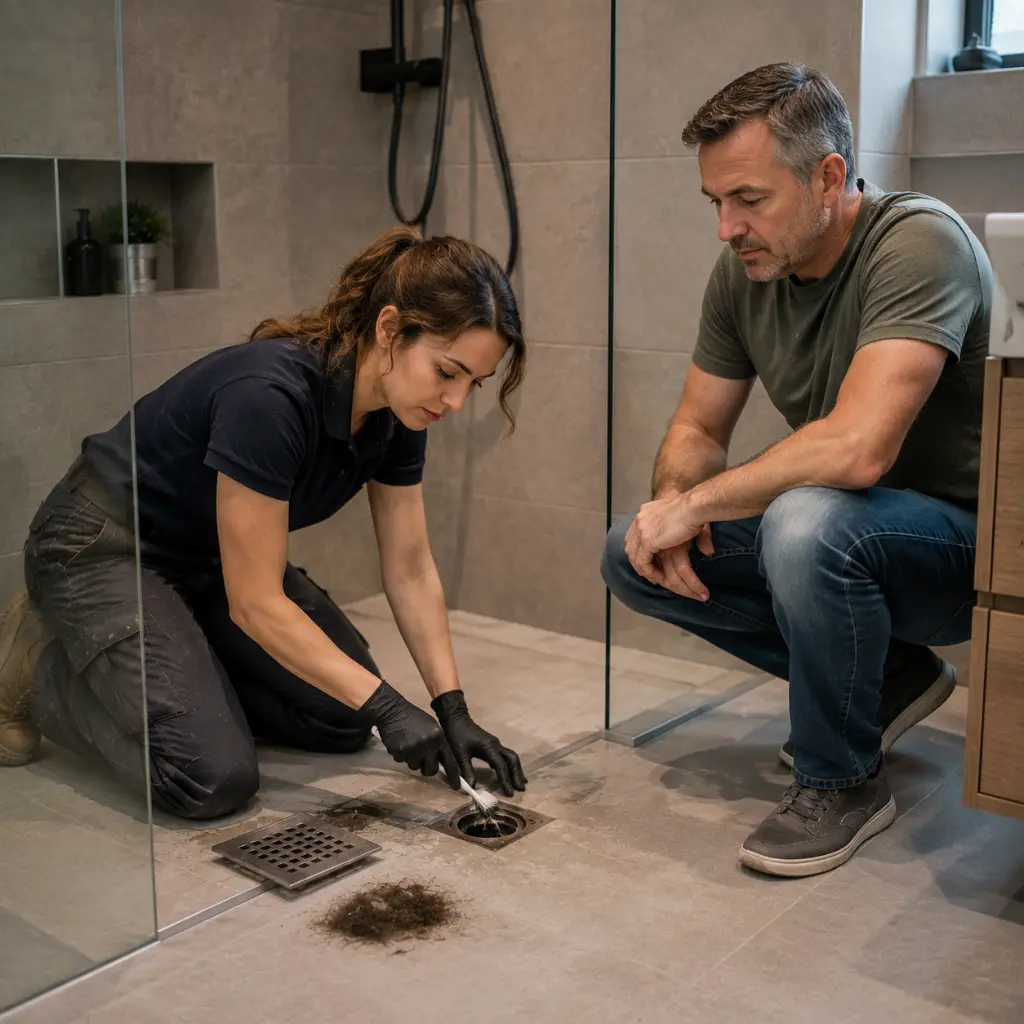
Mechanical cleaning is what actually shifts it. A stiff bottle brush worked around the inside of the waste, or the trap taken off and washed out, removes far more than anything poured in.
The spots people forget to check
When a smelly bathroom drain resists the obvious fixes, it is usually because the source is not the plughole at all.
Basin and bath overflows are the first place to look. That channel holds the same build-up as the waste but never gets flushed properly, and the slot sits at nose height on a basin.
Shower traps come next, because most of the hair in a bathroom collects there. Many gratings lift out with a screwdriver to give access to a removable insert, though a trap buried under a tray with no access panel leaves you nothing to reach. Access is decided at design stage rather than afterwards, which is one of the quieter differences between a wet room and a walk-in shower on a tray, since a floor gully is cleared from above while a tray waste is often only reachable from below.
Then there is the WC. A perished pan connector or a failed seal at the soil pipe leaks gas rather than water, so there is nothing visible to spot, and the smell is strongest low down near the floor.
Boxed-in soil stacks hide the same problem. In the Harrow homes TG Handyman London is called to for odour hunts, the answer often turns out to be a joint inside the boxing rather than anything in the bathroom itself.
Cleaning it out without damaging the pipework
Start with hot water rather than boiling, since water straight off the boil can soften plastic waste fittings and loosen compression joints over time. A kettle of hot tap water followed by a flush of the tap does the job safely.
For the build-up, an enzyme based drain treatment left overnight digests the organic layer instead of just burning through the middle of it. Repeating it monthly keeps a problem drain in check.
Caustic and acidic drain openers are worth avoiding in a bathroom. They are aimed at blockages rather than odour, they sit in the trap where they can attack seals, and mixing products, particularly anything with bleach, releases dangerous fumes.
Fit a hair catcher in the shower and clear it weekly. It is the single change that keeps the trap clean, and it takes seconds.
When the problem is beyond the bathroom
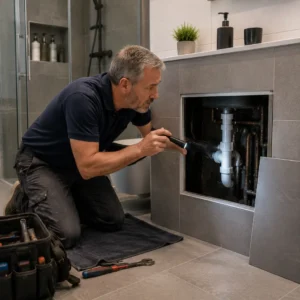
A few signs mean the fitting is not at fault. Several drains smelling at once, gurgling from a WC when a bath empties, or water backing up somewhere all suggest a restriction in the drainage rather than a dirty trap.
Smells outside near a gully or an inspection chamber point the same way. Lifting the cover and looking for standing water gives a quick indication, and a persistent blockage may need a camera survey.
Responsibility matters here too. Drains within your boundary serving only your property are yours to maintain, while shared drains and the lateral drain beyond the boundary generally sit with the water company, so it is worth confirming before commissioning work.
Working through it in order
A smelly bathroom drain is nearly always solvable in a single afternoon once the cause is identified rather than guessed at. Check the seal, clean the trap and overflow, then widen the search to the WC and the stack.
If the odour survives all of that, treat it as a drainage fault and stop pouring things down the plughole. At that stage you are dealing with the system, not the fitting.
Get it traced properly
If the smell keeps coming back, having someone open up the traps and check the vent arrangement usually settles it quickly. TG Handyman London covers Harrow, Wealdstone, Pinner, Stanmore, Kenton and Edgware, fully insured and with no call-out fee. Request a free, no-obligation quote and we will find out where the odour is really coming from.